

Kidney Stone
HOW KIDNEY STONES DEVELOPA kidney stone can form when substances such as calcium, oxalate, cystine, or uric acid are at high levels in the urine. Stones can also form if these substances are at normal levels, especially if the amount of urine made each day is low. The substances form crystals, which become anchored in the kidney and gradually increase in size, forming a kidney stone.
Typically, the stone will move through the urinary tract and is passed out of the body in the urine. A stone may cause pain if it becomes stuck and blocks the flow of urine. Large stones do not always pass on their own and sometimes require a minimally invasive surgical procedure to remove them.
KIDNEY STONE RISK FACTORSCertain diseases, dietary habits, or medications can increase your risk of developing kidney stones.
KIDNEY STONE SYMPTOMS- Pain — Pain is the most common symptom when passing a kidney stone. Most commonly, pain only occurs with obstruction, in which the urine cannot pass freely from the kidney to the bladder. Pain can range from a mild and barely noticeable ache to discomfort that is so intense it requires treatment in the hospital. Typically, the pain gets worse and better, but does not go away completely. Waves of severe pain, known as renal colic, usually last 20 to 60 minutes. Pain can occur in the flank (the side, between the ribs and the hip) or the lower abdomen (figure 1), and the pain can move toward the groin.
- Blood in the urine — Most people with kidney stones will have blood in the urine (hematuria). The urine may be pink or reddish, or the blood may be visible only with urine dipstick testing or microscopic examination of the urine.
- Gravel — You may pass "gravel" or "sand," which are small stones in your urine
- Other symptoms — Other kidney stone symptoms include nausea or vomiting, pain with urination, and an urgent need to urinate.
- Asymptomatic kidney stones — Many people with stones that remain in the kidney and do not cause obstruction have no symptoms (asymptomatic means without symptoms). These kidney stones are usually found when an imaging study (such as an ultrasound, X-ray or CT scan) is performed for other purposes. Stones can remain in the kidneys for many years without ever causing symptoms. KIDNEY STONE DIAGNOSIS
- Computed tomography (CT) scan — A CT scan creates a three-dimensional image of structures within the body. A particular type of CT scan (called noncontrast helical CT) is often recommended if kidney stones are suspected because it is the best imaging test to see a kidney stone.
- Ultrasound — An ultrasound (or sonogram) can also be used to detect kidney stones, although small stones or stones in the ureters (tubes that connect the kidney to the bladder) may be missed. However, ultrasound is the procedure of choice for people who should avoid radiation, including pregnant women and children.
Kidney stones are usually diagnosed based upon your symptoms, a physical examination, and imaging studies.
It is done by PCNL, RIRS, Mini PCNL, Lithotripsy & Laparoscopy Surgery.
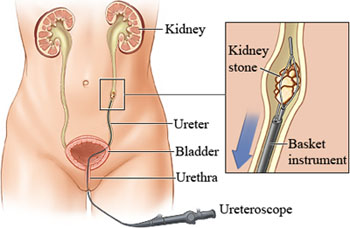
Ureter Stone
Urine travels from the kidney to the bladder through tubes called ureters. A ureter stone is a mineral mass in the ureter, which may or may not have originated in the kidney and traveled down into the ureter. A stone begins when particles of minerals in stagnated urine crystallize and form a mass.
If small enough, a stone can disengage and pass through the ureter and out of the body unnoticed. If it is too large, it may lodge in the ureter and obstruct the flow of urine.
Symptoms Causes and Risk FactorsWhile the causes of ureter stones are unknown, individuals with a family history are more likely to be at risk. Certain metabolic disorders are also associated with the formation of stones, as are cystic kidney diseases and urinary tract infections.
TreatmentIt is done by URS,RIRS, Lithotripsy & Laparoscopy Surgery.
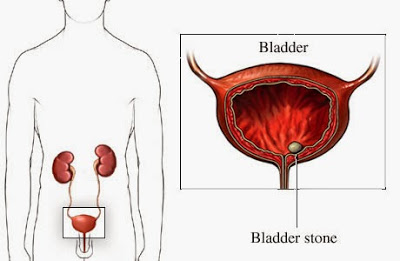
Bladder Stone
Bladder stones are hard masses of minerals in your bladder. They develop when the minerals in concentrated urine crystallize and form stones. This often happens when you have trouble completely emptying your bladder.
Small bladder stones may pass without treatment, but sometimes bladder stones need medications or surgery. Left untreated, bladder stones may lead to infections and other complications.
Symptoms
Sometimes bladder stones — even large ones — cause no problems. But if a stone irritates the bladder wall or blocks the flow of urine, signs and symptoms may include:
- Lower abdominal pain
- Pain during urination
- Frequent urination
- Difficulty urinating or interrupted urine flow
- Blood in the urine
- Cloudy or abnormally dark-colored urine
- Request an Appointment at Mayo Clinic
Causes
Bladder stones can develop when your bladder doesn't empty completely. This causes urine to become concentrated urine, and then it may crystallize and form stones.
Some infections can lead to bladder stones, and sometimes an underlying condition that affects the bladder's ability to hold, store or eliminate urine can result in bladder stone formation. Any foreign materials present in the bladder tend to cause bladder stones.
The most common conditions that cause bladder stones include:
Prostate gland enlargement. An enlarged prostate (benign prostatic hyperplasia, or BPH) can cause bladder stones in men. An enlarged prostate can obstruct the flow of urine, preventing the bladder from emptying completely.
Damaged nerves. Normally, nerves carry messages from your brain to your bladder muscles, directing your bladder muscles to tighten or release. If these nerves are damaged — from a stroke, spinal cord injury or other health problem — your bladder may not empty completely. This is known as neurogenic bladder. Other possible causes of bladder stones include:
Inflammation. Bladder inflammation, sometimes caused by urinary tract infections or radiation therapy to the pelvis, can lead to bladder stones.
Medical devices. Bladder catheters — slender tubes inserted through the urethra to help urine drain from your bladder — may cause bladder stones. So can objects that accidentally migrate to your bladder, such as a contraceptive device or urinary stent. Mineral crystals, which later become stones, tend to form on the surfaces of these devices.
Kidney stones. Stones that form in your kidneys are not the same as bladder stones. They develop in different ways. But small kidney stones may travel down the ureters into your bladder and, if not expelled, can grow into bladder stones.
It can be done by Laser Surgery, Cystolithotripsy, PCCL & Open Surgery.
